

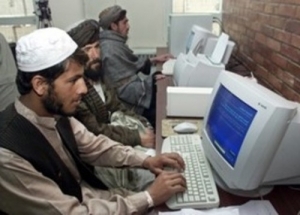
Despite the media spotlight on the progress and challenges of the peace process and reconstruction in Afghanistan, a series of Internet network initiatives are quietly underway that are transforming education and research within the country. Jointly funded by NATO’s Science for Peace and Security Programme and the U.S. Department of State, the SILK-Afghanistan project currently connects 18 Afghan universities which will benefit further from a national fibre optic network programme currently under construction. A new organisation, AfgREN, is being set up to manage a dedicated national research and education network (NREN) for the country, a model successfully proven around the world.
Today, further initiatives are announced which will increase Afghanistan’s links with the global research and education community. Capacity has been immediately doubled on the SILK-Afghanistan project’s link to the pan-European GÉANT network. Looking to the future, Afghanistan has also joined the pan-Asian TEIN research and education networking project, and a new high-speed network connection to the TEIN network backbone is planned for 2015.
The new initiatives mean that Afghan scholars will be able to gain qualifications through multimedia-based distance learning while researchers can work on international projects, all without needing to leave their home country to pursue their studies and research.
Minimising the brain drain of qualified citizens will be central to efforts to rebuild the country, benefiting all Afghans. Collaborative global projects in areas such as crop research and disaster relief can improve living standards by bringing together expertise from around the world with local specialists on the ground. As well as these vital programmes for economic and societal development.
"These new initiatives enable Afghanistan to take its place in the global research and education community," said Professor Obaidullah Obaid, Minister for Higher Education, during the opening ceremony of AfgREN. "This will accelerate our collaboration with colleagues across the world, increasing the opportunities for our students and researchers and benefiting the entire country." Salim Saay, Director of IT in the Ministry and Manager of AfgREN, added: "Through AfgREN we plan to provide a national network and IT services for higher education across Afghanistan".
Following a planning stage, provision for Internet access for Kabul University by NATO commenced in 2006 and was subsequently expanded to include 14 provincial universities with the launch of the SILK-Afghanistan project in 2010. In spring 2013, it was extended to June 2015 with continuing funding from both donors.
Connection capacity to GÉANT has been increased from 75 Mbps to 155 Mbps, with Internet traffic between Kabul and the Vienna hub now running solely on terrestrial fibre optic networks, connecting an estimated 70,000 Afghan students, teachers and researchers with GÉANT’s 50 million users at 10,000 institutions across Europe.
By also joining the TEIN project, Afghanistan will gain access to the expertise, support, technical knowledge, training and opportunities for collaboration provided by the world’s largest regional research and education network. Planning is now underway for a direct connection to the TEIN network backbone which currently serves over 50 million users in 16 connected Asia-Pacific countries.
"We look forward to working with AfgREN as a member of TEIN in fostering our common goal of increased international research collaboration between Asia and Europe," said Jean-Claude Boidin, Head of Unit Regional Programmes, Asia and Central Asia, DG DEVCO, European Union. "This is a positive step forward in global research collaboration that will benefit everyone involved."
"Over the past 20 years DANTE has been dedicated to expanding global collaboration. So it is immensely satisfying to see Afghanistan join the global research and education networking community," said David West, Regional Project Manager at DANTE. "As the organisation originally responsible for establishing the TEIN project it is great to see it reaching out to Afghanistan and bringing research and education networking to help the Afghan people rebuild their lives and institutions."
"We welcome Afghanistan to TEIN’s growing community and look forward to working with AfgREN to develop research networking in the region," said Tae-Hee Lee, President, TEIN*CC, the Korean not for profit organisation that now manages the TEIN project. "TEIN was founded on a commitment to connect the unconnected across Asia and Afghanistan’s geographical position made it a natural candidate to join the community, increasing links to Asia and the rest of the world."
About DANTE
DANTE (Delivery of Advanced Network Technology to Europe) is a non-profit organisation established in 1993 that plans, builds and operates large scale, advanced networks for research and education (R&E). On behalf of Europe’s National Research and Education Networks (NRENs), DANTE has built and operates GÉANT, a flagship e-Infrastructure key to achieving the European Research Area.
Working in cooperation with the European Commission and in close partnership with Europe’s NRENs and international networking partners, DANTE remains fundamental to the success of global research collaboration.
DANTE established and coordinated the regional R&E network for Asia-Pacific, TEIN, from 2004 to 2012, when project management was transferred to Korea-based TEIN*CC. In addition to continuing to support the TEIN project, DANTE currently manages R&E networking projects serving the Mediterranean (EUMEDCONNECT), Sub-Saharan Africa (AfricaConnect) and Central Asia (CAREN) regions and coordinates the Europe-China collaboration (ORIENTplus). DANTE also supports R&E networking organisations in Latin America (RedCLARA) and the Caribbean (CKLN). For more information, visit www.dante.net and www.geant.net
About TEIN*CC
TEIN*CC (Trans-Eurasia Information Network-star Cooperation Center) was established in August 2011 by the Korean Government and with TEIN partner support as a non-profit Foundation Corporation to take responsibility for the 4th phase of the TEIN programme which started in April 2012. It is located in Seoul with funding provided by the Korean Ministry of Science, ICT and Future Planning. TEIN*CC will continue to develop the network up to 2016 with DANTE support. TEIN continues to receive funding support from the European Commission which is contributing €8 million for TEIN4.
TEIN*CC and the continuation of the TEIN programme were endorsed at the ASEM9 Summit in 2012 in Lao PDR where leaders recognised the important role played by the TEIN project in increasing direct internet connectivity among research and education in Asia and between Asia and Europe. For more information, visit www.teincc.org and www.tein.asia
About AfgREN
The Afghanistan Research and Educational Network (AfgREN) is responsible for providing a high- speed Internet backbone and other IT services for universities, Higher Education institutions, colleges, teaching hospitals, libraries, research and scientific centres across Afghanistan. AfgREN is one of the major projects of the Ministry of Higher Education’s (MoHE) Strategic Plan and has been identified as key enabler of the Higher Education system. AfgREN is supported by the SILK-Afghanistan Programme and is managed by the MoHE.
For more information, visit www.mohe.gov.af/?lang=en
About SILK-Afghanistan
SILK-Afghanistan is the successor project of NATO’s Virtual Silk Highway (SILK project) in Afghanistan. Named after the ancient trade route between Asia and Europe, the SILK project was set up to provide free high-speed internet access via satellite to the academic communities of the Caucasus and Central Asia. In 2004, the SILK project was extended to Kabul University, Afghanistan, and subsequently to three additional Kabul-based universities by 2008. The successor project SILK-Afghanistan extended connectivity to 14 provincial universities between the end of 2009 and early 2011. Whereas the original Virtual Silk Highway project with beneficiaries in Central Asia and the Caucasus was handed over to the co-sponsorship of the European Union in 2009/2010, the NATO and United States Department of State-sponsored SILK-Afghanistan project is currently expected to continue until summer of 2015. In addition to free Internet access, Afghan universities also have the option to apply for NATO networking infrastructure grants and training assistance of their IT staff. NATO’s Science for Peace and Security (SPS) Programme provides the funding for NATO’s share in this jointly funded project.