
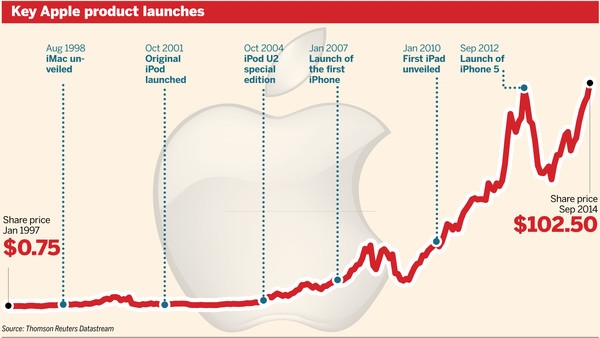
Apple is not just unveiling a new iPhone next week. It is reintroducing the company. That is the buzz building around what many in Silicon Valley see as the most significant event for Apple since the death in 2011 of Steve Jobs, its co-founder, according ft.com. While recent years have seen a familiar series of incremental upgrades to the device that reinvented mobile phones, Apple keynote on Tuesday is expected to be an attempt to reposition the iPhone as the centre of not just the digital world of apps, music and messages but the physical environment too, encompassing health, money and the home. The company will also hope that it helps bring to a close an embarrassing security breach, in which the accounts of some celebrities including actress Jennifer Lawrence were hacked and intimate photos released online.
In doing so, Tim Cook, chief executive, hopes to turn round a creeping perception that the company can no longer innovate like it once did.
After staring down competition from Samsung, which is now struggling in the premium end of the smartphone market that the iPhone dominates, Apple wants to reclaim the initiative, said Benedict Evans, partner at tech investor Andreessen Horowitz.
For Apple’s leadership, “this is the coming out party”, said Mr Evans. “We are now well out beyond the Jobs era.”
The big question is whether its new gadgetry can dazzle in the same way as the iPod, iPhone and iPad when they were launched. One former Apple employee, who still works in Silicon Valley and asked not to be named, said the event would be an “acid test” for Jobs’ successors.
“It’s three years since Steve died so whatever they announce is either the last [product] that he had a direct input on or the first thing he did not even see,” the person said, noting Apple’s lengthy product development cycle.
Apple telegraphed the significance of Tuesday’s event with its choice of location. The Flint Center in Apple’s home town of Cupertino is notable for being where Jobs unveiled the original Macintosh computer 30 years ago and the new iMacs in 1998, at his first event after returning to the company.
“The choice of venue certainly signals that they see this as one for the ages,” said Jan Dawson, founder of Jackdaw Research. “They clearly see this as a major milestone.”
A vast two-storey structure being built behind the Flint Center, believed to be where reporters and other attendees will be able to test out the latest kit, also points to something on a different scale to previous Apple events.
“Jobs had a magician-like ability to reset the agenda in the world and make people feel that what he thought was cool, everyone will think is cool,” said Gadi Amit, founder of New Deal Design, a San Francisco design agency that has worked with the likes of Google and Fitbit, a maker of health tracking devices.
Two new iPhones, with larger screens expected to be made of a tough new sapphire material, have been well trailed. Less is known, however, about what pundits have dubbed the iWatch: Apple’s first foray into wearable computing and its first new product category since the iPad.
While recent Apple recruits from sports, fashion and healthcare technology start-ups suggest the device will aim to be stylish and practical, it will be up to Mr Cook and his lieutenants to explain why customers need yet another screen in their lives.
New recruits such as Paul Deneve, the former chief executive of fashion house Yves Saint Laurent who now leads Apple’s “special projects”, and Angela Ahrendts, the head of retail it poached from Burberry earlier this year, are yet to make their first appearances onstage with Apple.
The company’s invitation to the event simply invoked Mr Cook’s bland response to questions about future products: “Wish we could say more.”
One Apple insider suggests that the significance of the word “more” should not be underestimated: attendees will be stunned by the sheer volume of innovations shown off on Tuesday, he said, as Mr Cook steps out from his predecessor’s shadow.
At what will be the eighth iPhone launch event, some say extra pizzazz is overdue.
While Mr Amit sees yet another iPhone as “kind of boring”, he has high expectations for its new wristband. “They have almost committed to present something big,” he says. “They will be judged quite harshly if it’s not.”
The stakes are high because Apple’s chief smartphone rivals have a head start in figuring out this new frontier. Google’s Android Wear has seen wide adoption from manufacturers such as LG and Sony. Samsung is already on the sixth iteration of its Gear wristbands. Intel this week attempted to out-style Apple by unveiling the Mica, a smartwatch made in collaboration with hip retailer Opening Ceremony, at New York Fashion Week.
But in many ways, the wearables market resembles digital music players before the iPod or smartphones before the iPhone: the technology exists but nobody has pulled it together in a package that has really struck a nerve with consumers.
“There really isn’t a market for wearables yet,” says Ben Bajarin, analyst at Creative Strategies. “You struggle to find the value proposition and the reason for Apple to do it.”
After such high expectations have been created, perhaps Apple’s biggest risk is that it cannot live up to its own hype. Apple’s long-awaited big push into television, for instance, is unlikely to make an appearance anytime soon.
Sources have told the Financial Times that while Apple will demonstrate its new wearable device next week, it is unlikely to go on sale until early 2015, missing December’s lucrative holiday shopping season. When it does finally arrive, Citi Research analysts predict that the financial impact will be “quite small” in its early years, at just 2 or 3 per cent of Apple’s total current revenues.
The company’s imminent bid to turn the phone into a digital wallet, using short-range wireless technology, follows lacklustre attempts by Google and other mobile operators. Even if it is more successful, Horace Dediu, analyst at Asymco, cautioned that payments are “not a particularly profitable business” in and of themselves.
“The real impact of the decision to support payments will be in the aura surrounding the iOS ecosystem,” he said in a blogpost. “An aura which will glow intensely.”
In the near term, the role of the new wristband and mobile payments service, as well as other initiatives such as health tracking and the “connected home”, are to keep people loyal to the iPhone and renew Apple’s halo of innovation.
“This is not something that needs to be considered revolutionary or giant within its first iteration,” says Mr Bajarin.
While many investors’ eyes will be on Mr Cook’s performance on Tuesday, Mr Evans at Andreessen Horowitz says that it is ultimately the quality of the devices that will determine their success.
“One can get distracted by the keynote but fundamentally it’s about the right product,” he said. “I don’t think that needs Steve Jobs to get up on stage and explain it.”