


Dutch fixed telephony sales fell in 2016 by 9.3 percent to EUR 1.1 billion, according to Telecompaper’s latest Dutch Fixed Telephony Market. The revenue decline, which began in 2013, is due to less use and lower prices. In the fourth quarter, sales decreased 0.3 percent to EUR 270 million.
Dutch are making less calls from their landline phone. The number of connections has decreased over the years, especially with the advent of mobile phones. In 2016, the number of fixed telephone lines slid 0.5 percent to 6.27 million in December. The growth of 1.8 percent in the number of digital telephone lines was not enough to offset the decline in traditional telephony, compared to PSTN/ISDN.
The number of digital telephone lines amounted to more than 5.6 million at the end of December. The increase came entirely from fibre VoIP, which advanced 15.2 percent from 2015. VoIP telephony via both cable or DSL slipped lower last year. Cable VoIP is still the largest digital telephony technology with 2.66 million connections, followed by DSL with 2.06 million connections. Fibre VoIP amounted to over 913,000 lines at end December 2016.
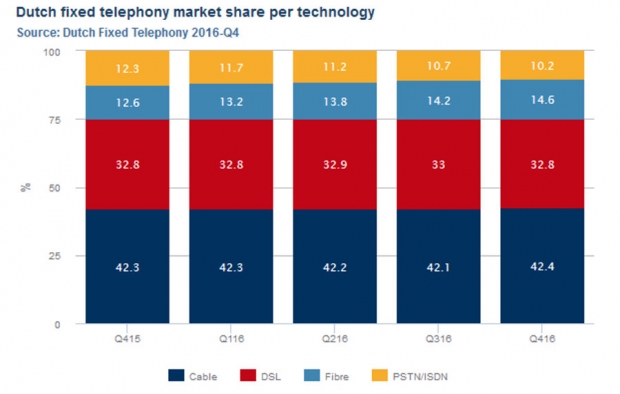
For the coming years, Telecompaper expects a similar pattern: a slight decrease in the number of fixed telephone lines, with growth at VoIP telephony via fibre unable to offset the decline in traditional telephony and DSL VoIP. Revenues will also continue to decline on the back of cost differencs, with KPN's VoIP over DSL/fibre virtually free, compared to EUR 12-21 for traditional telephony.
Telecompaper expects revenue and volume decline trends to continue in the coming years, with revenues dropping more rapidly. For the period running from 2017 to the end of 2021, connections will go lower by 0.9 percent and revenues by 5 percent.