

Orange launched its own-brand virtual reality (VR) headset on 20 October 2016, becoming the first operator to do so.1 The device will be available to consumers in five of its European markets in time for Christmas. The significance of this announcement goes beyond the launch of another VR headset, of which more than a dozen alternatives already exist, according analysysmason.com. The move in fact signals the first step in Orange’s strategy to become involved throughout the VR value chain. This is a bold move by Orange – the operator is stimulating a nascent market beyond mere connectivity revenues by providing early-adopters with an affordable entry-level VR experience. This initiative may help Orange gain a better understanding of consumer demands around VR and iterate accordingly, even if it is not ultimately successful.
The VR1 headset aims to democratise access to VR content
The Orange VR1 has been tentatively priced at EUR49.99 and is designed to provide a good entry-level VR user experience. This represents a more-affordable price point than those of competing headsets, such as Google’s Daydream View (EUR69) or Samsung’s Gear VR (EUR99). The VR1 is similar to these devices, in that it requires users to insert their smartphones into the headset to act as the device’s screen. However, the VR1 comes with integrated earphones, in contrast to Google and Samsung’s headsets, and is also compatible with Apple’s iPhone handsets, which neither Google nor Samsung’s headsets support.
Orange has either developed the capabilities to provide solutions or acquired them throughout the VR value chain
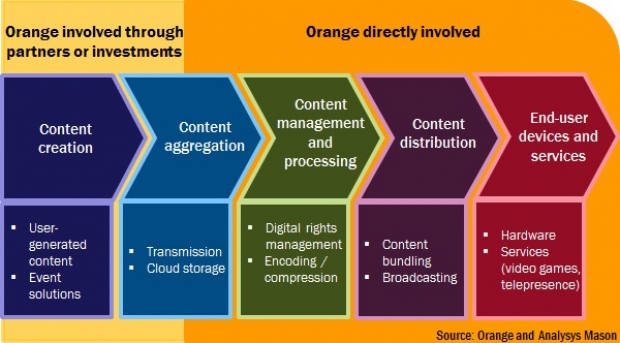
The VR1 headset is only one of the VR value chain activities in which Orange is involved (see Figure 1). The operator has either developed solutions internally or has invested in companies that provide capabilities across the entire VR content creation, distribution, and consumption value chain.
Figure 1: Orange’s role in the VR content value chain
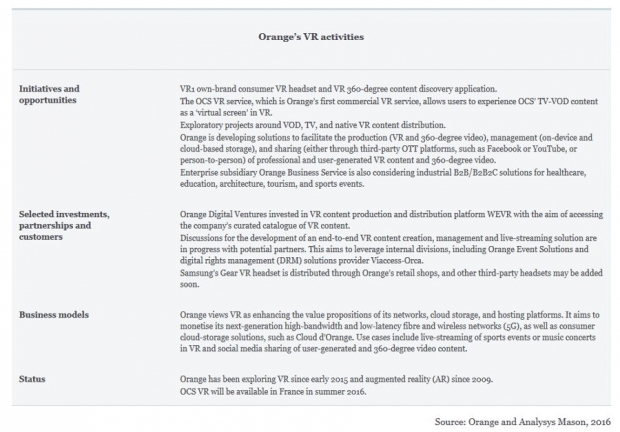
Orange aims to monetise both professionally-produced and user-generated VR content through some of its consumer and enterprise divisions. The operator has identified the potential of VR to strengthen the value proposition posed by its combination of network, cloud, TV, DRM, and live events solutions (see Figure 2).
Content aggregation, management, and distribution: transmission and storage of 360-degree video and VR content as part of connectivity or TV/video packages2 – use cases include user-generated content and immersive event video (such as sport or concerts).
VR communications services: telepresence and teleconferencing, B2B and industrial applications (for example, in architecture, medicine or engineering).
Hardware bundling/subsidies: VR-ready hardware (headsets, cameras and VR-ready smartphones) together with content or access subscriptions.
Figure 2: Orange’s VR activities
Sharing of user-generated content could accelerate VR’s mainstream consumer adoption
We expect sharing of user-generated VR and 360-degree videos on social media to become a major driver for consumer adoption of VR content, despite the significant adoption barriers still facing the medium. The extent of this opportunity is underlined by the significant commitments that have already been made by technology giants. Facebook acquired headset manufacturer Oculus VR for USD2 billion in March 2014, Google is expected to release its Daydream mobile VR platform in November 2016, and Tencent has invested in both VR chat room developer AltspaceVR (July 2015) and Epic Games (June 2012), the studio behind the Unreal game and VR development engine. We have discussed the consumer and enterprise opportunities that VR presents to telecoms operators in more detail in our recent report.