

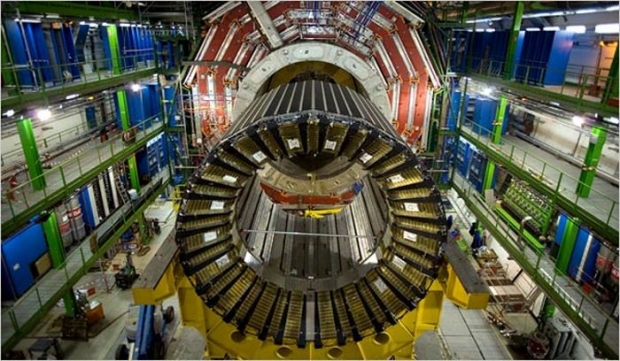
Romania has become a full member of the European Organization for Nuclear Research (CERN), the Ministry of Education informs in a release to Agerpres. The Council of the European Organization for Nuclear Research (CERN) gathered on Thursday in Geneva unanimously adopted the resolution concerning Romania's admission as full member of the European body. Romania's admission as a full member of this prestigious organization confirms the value and performance of Romanian researchers, physicians and engineers, involved in scientific researches within the large scale projects developed by the CERN, said the release. At present, Romania participates with 100 researchers in experiments conducted within The Large Hadron Collider - LHC and The Large Hadron Collider beauty - LHCb, A Large Ion Collider Experiment - ALICE, ATLAS and the global network GRID projects of CERN.
Established in 1954, the organization is based in a northwest suburb of Geneva that operates the largest particle physics laboratory in the world.
CERN's main activity is fundamental physics, all its projects targeting such themes that are considered as priorities at the level of the international scientific community as applicative research and technological development or training of the future specialists.
Romania had its first agreement signed with CERN in 1999 and became a candidate for accession to CERN on 11 February 2010.
At CERN, the European Organization for Nuclear Research, physicists and engineers are probing the fundamental structure of the universe. They use the world's largest and most complex scientific instruments to study the basic constituents of matter – the fundamental particles. The particles are made to collide together at close to the speed of light. The process gives the physicists clues about how the particles interact, and provides insights into the fundamental laws of nature.
The instruments used at CERN are purpose-built particle accelerators and detectors. Accelerators boost beams of particles to high energies before the beams are made to collide with each other or with stationary targets. Detectors observe and record the results of these collisions.
Founded in 1954, the CERN laboratory sits astride the Franco-Swiss border near Geneva. It was one of Europe's first joint ventures and now has 21 member states.
The name CERN
The name CERN is derived from the acronym for the French "Conseil Européen pour la Recherche Nucléaire", or European Council for Nuclear Research, a provisional body founded in 1952 with the mandate of establishing a world-class fundamental physics research organization in Europe. At that time, pure physics research concentrated on understanding the inside of the atom, hence the word "nuclear".
Today, our understanding of matter goes much deeper than the nucleus, and CERN's main area of research is particle physics – the study of the fundamental constituents of matter and the forces acting between them. Because of this, the laboratory operated by CERN is often referred to as the European Laboratory for Particle Physics.