

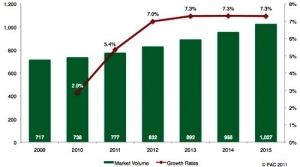
The year 2010 turned out to be a rather disappointing one for the IT market in Slovakia, as the growth rates that all IT suppliers had expected did not materialize and the volumes remained almost flat at previous year’s levels. "The most important reason behind this stagnation was the Public Sector and the general elections held in the country in June 2010. The elections brought about a change of government and the new administration is determined to fight the country’s deficits. The Information Technology sector has been hit very hard by the cost cutting and the new administration has stopped all the IT projects signed recently or in the process of being allocated, with few exceptions" explains Madalin Dobre, Consultant at PAC Eastern Europe.
This broad freeze on fresh IT investments lasted till Q2 of 2011 and it is only recently that the government has begun approving new projects, but that too in a sporadic manner. The government has also designed a new e-government strategy (OPIS - Operational Program for an Information Society) and a new procurement law which will guide IT Public tenders from 2011 onwards.
"However, the private sector has had a relatively better year in 2010, in terms of business generated. But this was not enough to have any significant impact on the level of IT investments, which have registered small, single digit growth rates. Despite significant growth in demand for manufactured goods, the manufacturers were not forced to invest to cope with the demand, they only had to fully utilize the already existing production plants/floors, and fresh investment in IT was not necessary" comments Madalin Dobre.
From a horizontal perspective, new large ERP implementations were not signed in the market, with the exception of couple core-banking solutions being rolled-out in Slovakia from the headquarters. End users continued to allocate funds for smaller-scale projects that would help them increase intimacy with the customers (CRM), increase their visibility and predictability on their customers (BI) and shorten the time to market. The tools segment mainly drove the software sector growth in 2010. The adoption of globally reputed application brands such as SAP or Oracle varies depending upon the sector. Manufacturing is by far the most penetrated sector, while adoption in the public sector is sporadic, custom-development still being the preferred solution.
The Slovak small-and-medium enterprises, from which a significant part of future IT sector growth is expected, are in the pole-position to be early adopters of as-a-Service delivery model. The SaaS model seems to attract more and more IT providers, of all sizes, and who are launching offerings, especially targeting this segment of the end-users.
Outsourcing is gradually increasing its share in the IT services business in Slovakia among local medium companies. However, it is still mostly derived from international agreements being followed in the local market or the local signing by international companies present in Slovakia.
Here on, an increase in growth rates is expected across all software and IT services. Manufacturing and banking sector are expected to increase focus on the applications area for long-term benefits, having largely focused for the last two years on infrastructure. Yet, the market expectations are fragile and business plans could change should there be a second wave of financial and economic crisis.