

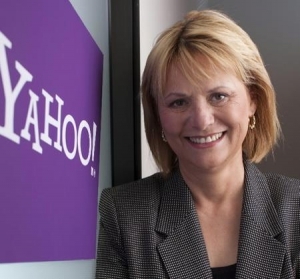
CFO Tim Morse appointed interim chief executive as struggling Internet company begins search for permanent replacement. Time ran out for Yahoo chief executive Carol Bartz (foto) late on Tuesday after she was unceremoniously fired by the troubled Internet company's board. Bartz had been under mounting pressure following a string of disappointing quarters during which she struggled to reverse Yahoo's ailing fortunes.
"The board of directors has appointed [CFO] Timothy Morse interim chief executive officer, effective immediately, replacing Carol Bartz, who has been removed by the board," said a statement from Yahoo. Bartz herself revealed the nature of her abrupt sacking in a brief but blunt email to all Yahoo staff that was shared with All Things Digital. "I am very sad to tell you that I've just been fired over the phone by Yahoo's chairman of the board," she wrote. "It has been my pleasure to work with all of you and I wish you only the best going forward."
A statement from chairman Roy Bostock thanked Bartz for her service during a "critical time of transition" for Yahoo, and insisted that the company has the assets it needs to be successful again. "We have talented teams and tremendous resources behind them and intend to return the company to a path of robust growth and industry-leading innovation," he said. "I would also like to express the board's appreciation to Tim [Morse] and thank him for accepting this important role," Bostock continued. "We have great confidence in his abilities."
Morse's services as CEO will only be required temporarily: Yahoo said it will engage the services of a "nationally recognised" executive search firm in order to find a permanent replacement for Bartz as soon as possible.
Whoever steps into the CEO role will have his or her work cut out for them.
Appointed in January 2009, Bartz won early praise for bringing a semblance of stability back to Yahoo. The company's share price had slumped during the 18-month tenure of her predecessor, Yahoo co-founder Jerry Yang, who struggled to grow the business after Microsoft withdrew its $44.6 billion takeover offer in May 2008.
There was cautious optimism swirling around the Sunnyvale, California-based company as Bartz moved quickly to slash costs, refocus on Yahoo's core display advertising business, and bring Microsoft back to the negotiating table, resulting in a 10-year partnership that would see Yahoo adopt the software giant's Bing search engine and Adcenter search advertising platform, while Microsoft would rely on Yahoo's sales force to court premium search advertisers. Yahoo would also receive a cut of the search revenue.
However, the early achievements did not translate into long-term revenue growth; analysts warned in the wake of one disappointing quarterly results call after another that Yahoo would not be able to cut its way to growth.
As reported by Total Telecom, indications that time was running out for Bartz came earlier this year, when an investor called for her resignation during a June shareholder meeting, a meeting that began with chairman Bostock re-emphasising his and the board's support for Bartz. This was followed by yet another lacklustre second quarter performance, with Bartz admitting during the subsequent results call that its Microsoft alliance had yet to bear fruit.
Yahoo was also negatively affected by a protracted dispute with Chinese e-commerce giant Alibaba, in which it holds a 40% stake. Yahoo accused Alibaba CEO Jack Ma of transferring ownership of the company's online payment unit Alipay to an entity he controlled without seeking board approval. However, Ma insisted that Alibaba's board, as well as Yahoo officials including Bartz, were made aware of Alipay's impending transfer, brought on by the need to comply with new Chinese Internet regulations. The saga became a source of much embarrassment for Yahoo and Bartz.
Investors welcomed news of Bartz's departure, sending Yahoo's share price upwards after the announcement. Whoever steps into Bartz's shoes will doubtless have every move they make heavily scrutinised by shareholders and industry observers alike.